GlobalTap: Globally Diverse Beat Tracking Benchmark
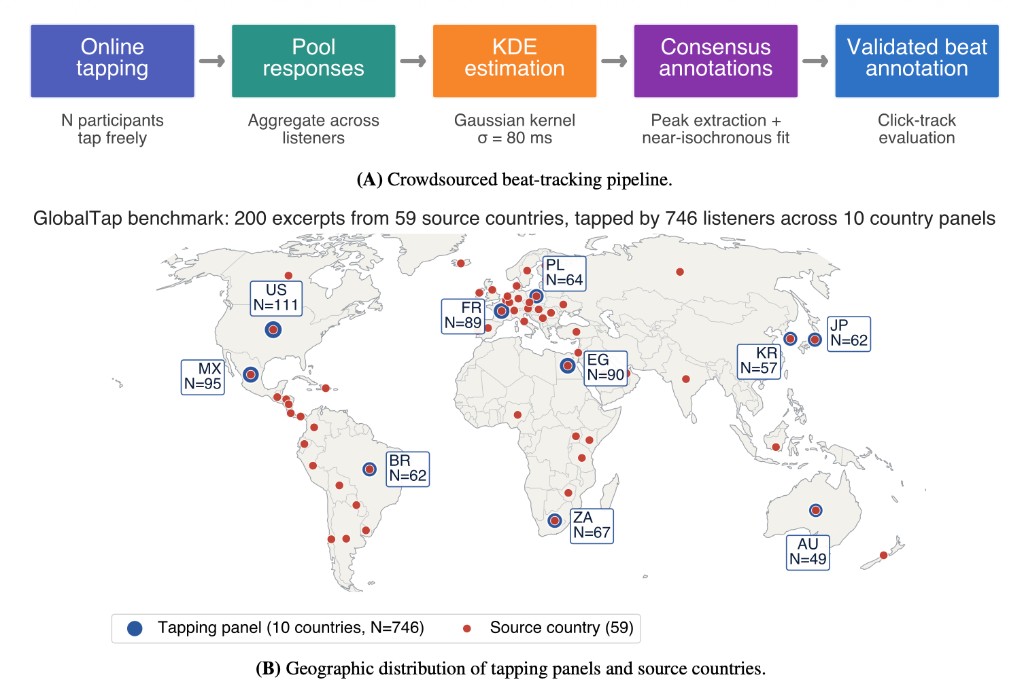
A crowdsourced beat-tracking benchmark of 200 popular-music excerpts from 59 countries, annotated by 746 participants tapping along online.
Existing beat-tracking benchmarks draw from a narrow range of musical cultures (predominantly Western ones) and are difficult to scale due to reliance on expert annotation. GlobalTap addresses both limitations with a 200-excerpt popular-music benchmark spanning 59 countries, annotated by 746 participants recruited across ten countries using a scalable online tapping pipeline.
Try it yourself: tap along with the crowd to the candombe recording where the crowd and the expert disagree, and see whose beat you hear.
Rather than asking expert annotators to manually place beat times, we collect large pools of tapping responses from online participants using REPP, a high-precision browser-based tool for sensorimotor synchronization experiments. Pooled tap times are smoothed into a density over perceived beat locations using Gaussian kernel-density estimation (σ = 80 ms), and a simple optimization step distills this density into a regularized consensus beat annotation. The resulting crowd-derived annotations are then validated by independent listeners rating click-track overlays.
Validation
In a separate study, a different 240-excerpt validation set was tapped by another 733 participants, and an independent group of 130 listeners rated how well each beat track lined up with the music. Across the 200 excerpts with existing reference annotations, we detected no overall difference in ratings between crowd-derived and reference annotations (Δ = −0.01, p = .231).
Crowd annotations occasionally diverged from the references in systematic ways: consistent phase offsets (on 71 of 145 excerpts where crowd and reference agreed on tempo, usually with the crowd tapping earlier), metrical alternatives (on 35 of 180 excerpts, the crowd annotation ran at half, double, or another rate), and bimodal pooled tapping showing more than one periodicity (31 of 180). Listeners did not consistently prefer the reference versions, suggesting that these disagreements often reflect different perceptual or structural interpretations rather than annotation errors.
Case studies
Candombe, phase offset. In this excerpt (Lobo 06) the crowd taps about 140 ms after the expert annotation, at the same tempo. The excerpt in the tap-along demo (Ansina 1, 02) shows the same effect at about 80 ms.
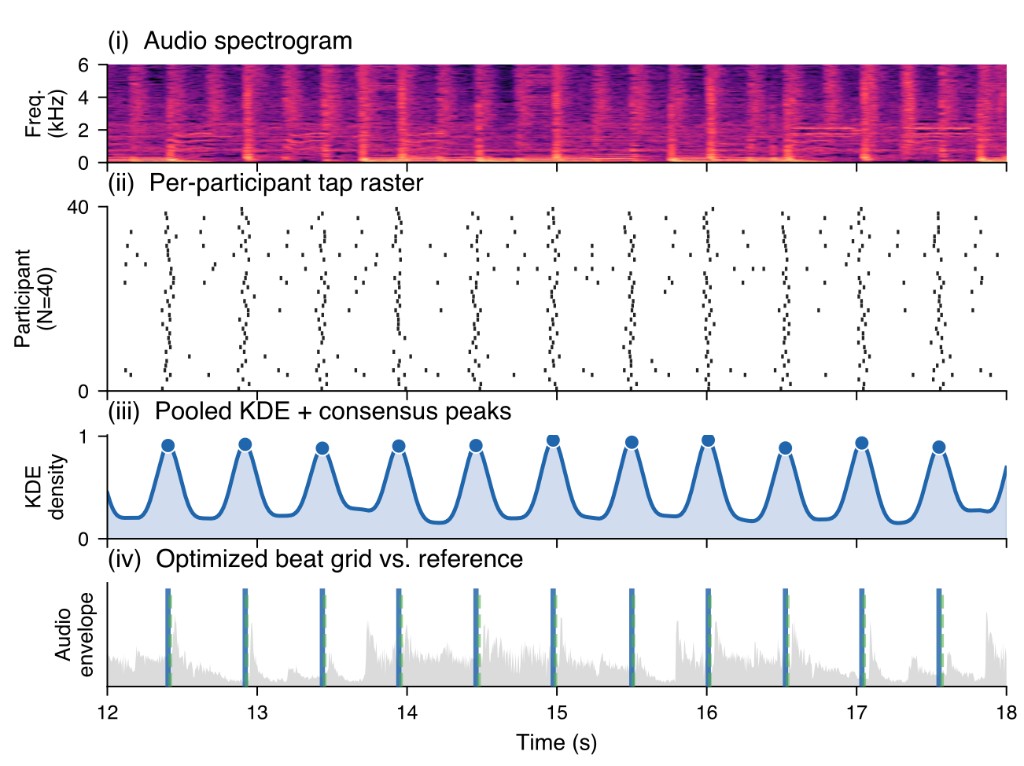
GTZAN Disco, simple alignment. KDE peaks track the optimizer grid through the entire window, and crowd and reference clicks are closely aligned.
What we do
- Collect large-scale online tapping data via REPP and PsyNet, recording taps via audio for high temporal precision.
- Aggregate pooled taps into consensus beat annotations using Gaussian KDE and a near-isochronous grid optimizer.
- Compute intrinsic quality measures (beat-sequence CV and inter-subject tapping coherence, ISTC) that flag perceptually difficult excerpts without requiring an external reference.
- Validate crowd annotations against existing references via a listener-rating experiment with 130 raters across 240 excerpts.
- Release the benchmark with consensus beat annotations, de-identified tap onsets, intrinsic confidence measures, and open-source pipeline code.
Why it matters
The main obstacle to culturally broader beat-tracking evaluation is not a lack of music, but a lack of scalable annotation methods. Expert annotations are expensive, require specialist musical knowledge, and do not easily transfer across cultural traditions. GlobalTap shows that online crowd tapping can help close this gap: listeners rated its annotations comparably to existing references, across diverse musical styles. By releasing raw tap times alongside consensus beats, the benchmark also makes perceptual ambiguity inspectable, contributing to cognitive research on beat perception as well as to computational modeling and music information retrieval.