A Robust Cross-Platform Solution for Online Sensorimotor Synchronization
A robust cross-platform solution for studying timing and coordination in large-scale online experiments.
Sensorimotor synchronization (SMS), the rhythmic coordination of perception and action, is a fundamental human skill that supports many behaviors, from repetitive daily routines to the highest forms of behavioral coordination, including music and dance. Research on SMS has been mostly conducted in the lab using finger-tapping paradigms, where participants tap with their index finger to a rhythmic sequence of auditory stimuli.
However, these experiments require equipment with high temporal fidelity to capture asynchronies between the time of the tap and the corresponding cue event, often in the tens-of-milliseconds range. SMS therefore poses a unique challenge for online research, where variability in participants’ hardware and software can introduce uncontrolled latency and jitter into recorded timestamps. Rhythm production experiments performed online can introduce delays on the order of 60–100 ms.
We have developed a novel technology, REPP (Rhythm ExPeriment Platform), that measures SMS in browser-based experiments with latency and jitter within 2 ms on average, while remaining practical for realistic data collection at scale.
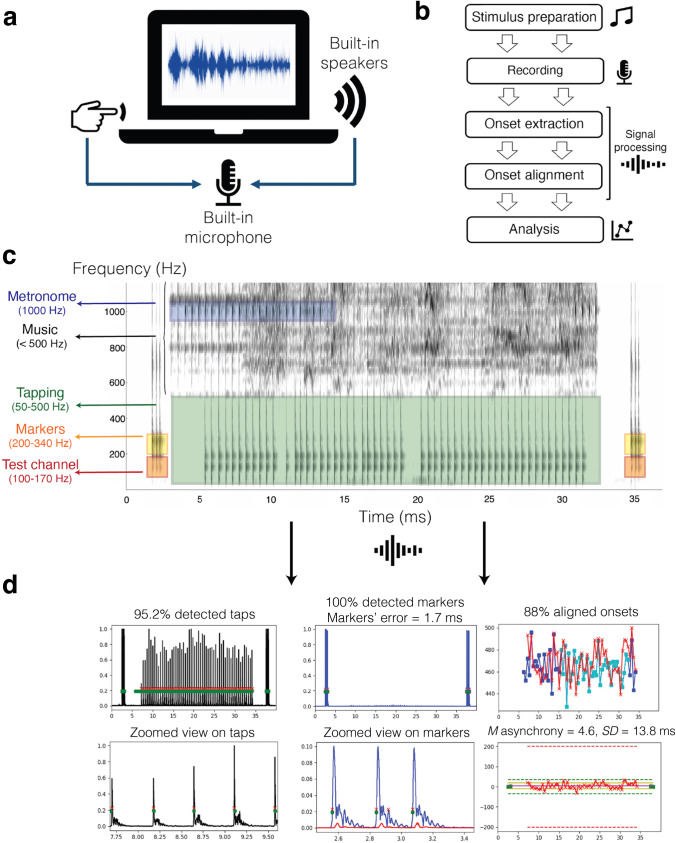
We have successfully collected large tapping datasets using REPP and validated the technology through a series of calibration and behavioral experiments. REPP reaches the quality levels of in-lab studies while massively increasing the scalability and speed of data collection, making research on SMS more accessible and efficient.
(Anglada-Tort et al., 2022; Niarchou et al., 2022; Nayak et al., 2025)
People on this project




Related Publications
2025
2022
-
Behavior research methods, 2022
-
Nature Human Behaviour, 2022