Human–AI Collaboration via Vibe Coding
Studying the necessity of human agency in iterative human–AI coding workflows using SVG generation.
As AI code generators become everyday tools, a pressing question emerges: what is the human’s actual role? Does human guidance improve outcomes, or can AI systems converge on good solutions alone? This project builds a controlled experimental framework for studying collaborative vibe coding: an iterative, natural-language style of programming in which people guide AI systems toward desired outputs without directly writing code.
We use Scalable Vector Graphics (SVG) as the coding medium because SVGs are easy to render, compare, and validate while still capturing the core challenge of translating high-level visual intent into executable code. The task allows us to manipulate who provides instructions, who selects outputs, and how information flows across iterations, making it possible to compare human-led, AI-led, and hybrid forms of collaboration under controlled conditions.
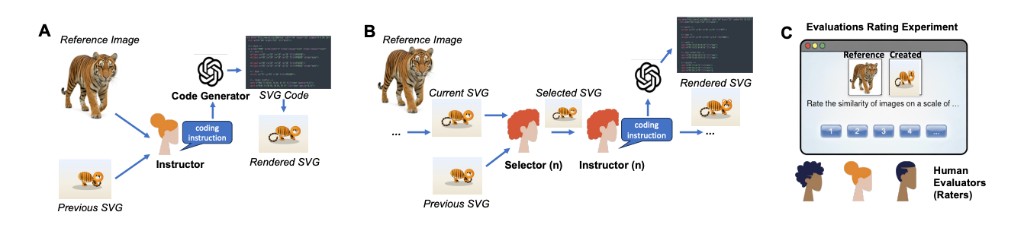
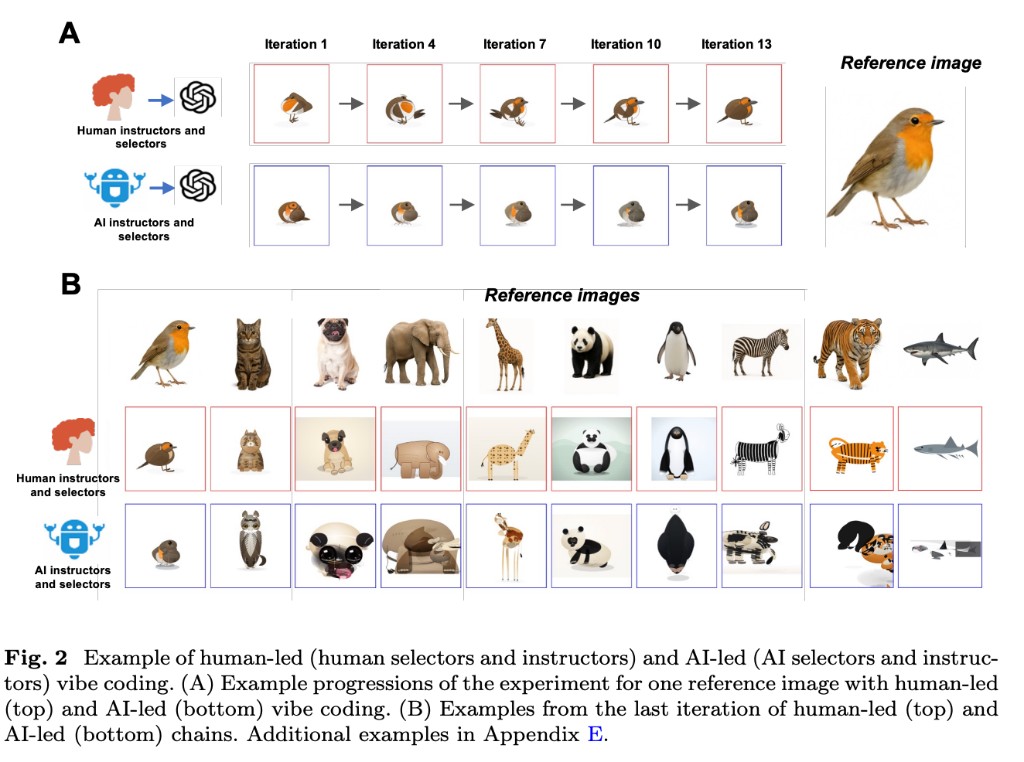
Across experiments, the project asks how labor should be divided in mixed human-AI systems. The results show that people provide uniquely effective high-level instructions for vibe coding, whereas AI-provided instructions can produce rapid drift or even performance collapse. Hybrid systems perform best when humans lead the process by providing instructions while evaluation is delegated to AI.
What we do
- Build an SVG-based experimental pipeline that makes human-AI collaborative coding measurable and causally controlled.
- Compare human-led, AI-led, and hybrid workflows across repeated iterations of instruction, generation, selection, and validation.
- Quantify when AI systems drift from human intent and when human guidance stabilizes creative search.
- Identify which parts of the workflow, including instruction and evaluation, are best handled by humans, AI systems, or hybrid arrangements.
Why it matters
Vibe coding is rapidly changing who can produce software and how creative technology work is done. Understanding when human involvement is essential, and when AI alone falls short, is critical for designing tools and workflows that amplify human agency rather than displace it. This project provides controlled evidence that human guidance can be a central ingredient in productive human-AI collaboration, especially when open-ended goals must be translated into concrete artifacts.
People on this project





Related Publications
2026
-
arXiv preprint 2602.10473, 2026