Collective Creative Search with Humans and AI
Studying how human–AI synergy supports collective creative search in a controlled semantic word-guessing task.
Generative AI is increasingly transforming creativity into a hybrid human–artificial process, but its impact on collective creative search remains unclear. This project studies human–AI synergy using a controlled word-guessing task that balances open-ended idea generation with an objective measure of task performance.
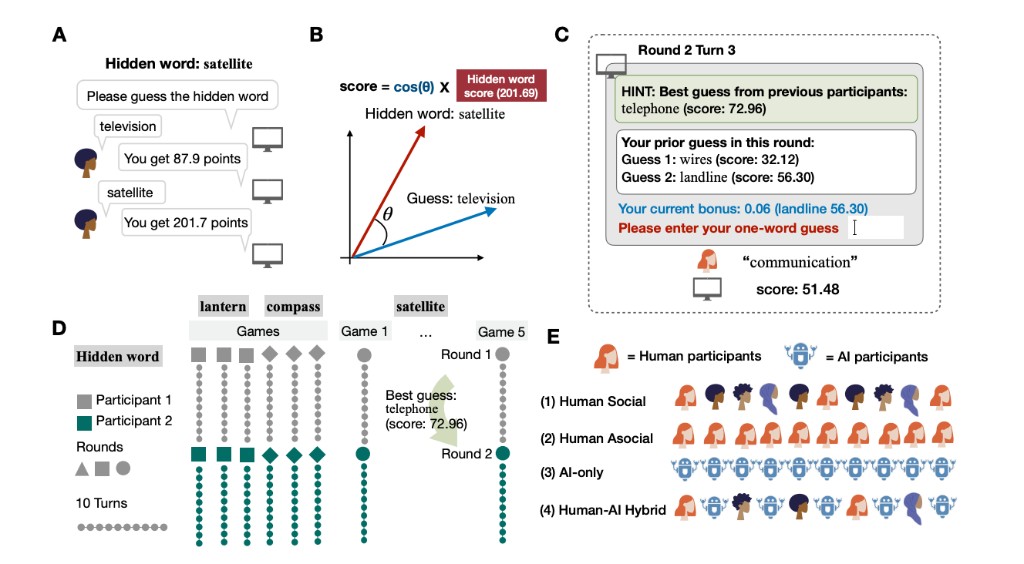
Participants attempt to infer a hidden target word, receive feedback based on the semantic similarity of their guesses to the target, and observe the best guess from previous players in the same chain. This creates a controlled form of collective creative search: people and AI agents explore a semantic space together, receive objective feedback, and inherit information from prior rounds.
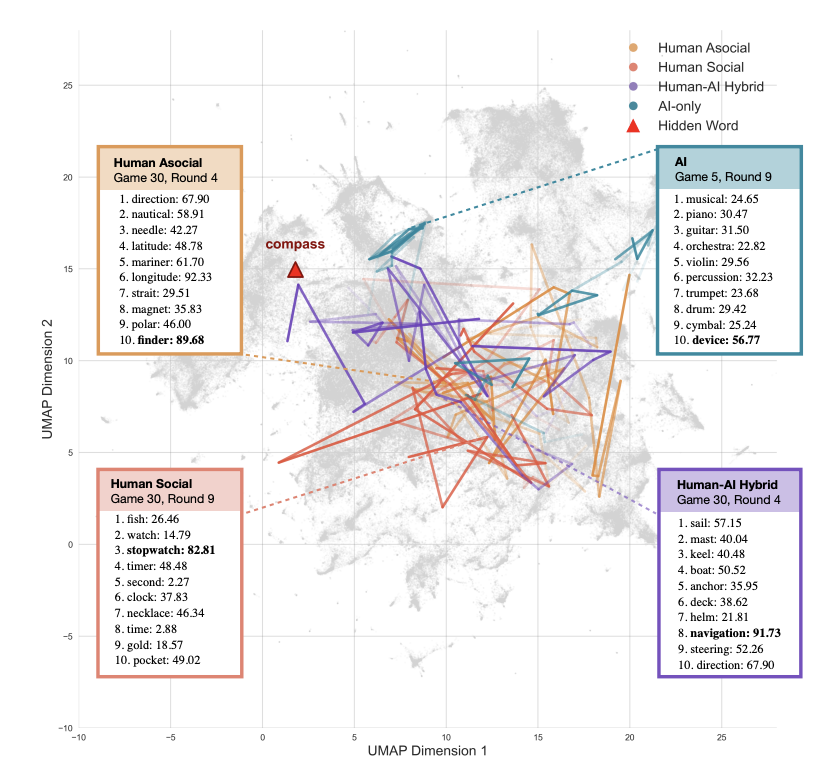
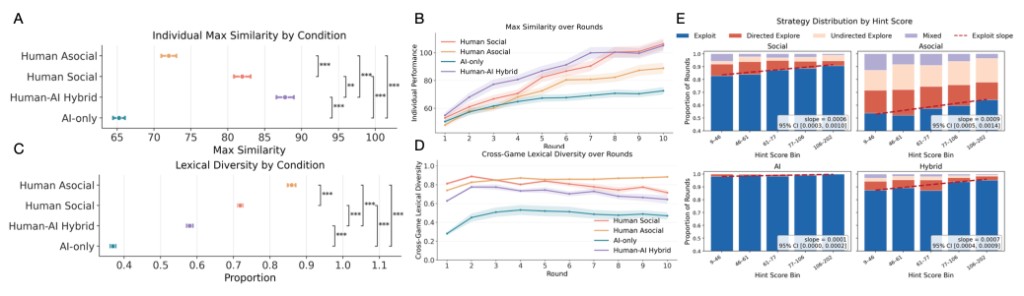
The new preprint compares Human Social, Human Asocial, AI-only, and Human–AI Hybrid conditions. Hybrid human–AI groups outperform both human-only and AI-only groups, while maintaining intermediate diversity and adaptive search strategies. Within hybrid groups, both humans and AI agents adjust their behavior relative to single-agent conditions: humans contribute broader exploratory signals, while AI agents exploit promising semantic regions more efficiently.
What we do
- Design controlled semantic search paradigms that combine open-ended creative exploration with objective performance metrics.
- Compare Human Social, Human Asocial, AI-only, and Human–AI Hybrid collective search across semantic spaces.
- Analyze how agents adapt their strategies in response to collaborators, social hints, and changing hint quality.
- Characterize the complementary roles of humans and AI: broad human exploration and efficient AI exploitation.
- Test whether performance benefits can be reproduced through heterogeneous AI–AI collaboration, including Gemini 2.5 and GPT-5.1 agents.
Why it matters
Hybrid human-AI groups outperformed both human-only and AI-only groups, demonstrating that the benefits of collaboration are synergistic. This advantage stems from complementary roles of human and AI: AI agents stuck rigidly to exploitation strategies regardless of hint quality, while humans adaptively balanced exploration and exploitation. When they are placed together, the benefit is asymmetric: human input pushed AI agents toward more varied and productive regions of semantic space, improving their performance and diversity, while humans’ own performance changed little, suggesting they served mainly as a source of exploratory signal. Critically, this synergy is not just about having diverse agents in the mix. Combining two different AI systems reproduced some of these gains, but human–AI collaboration remained superior. Together, these findings inform the design of creative AI tools, collective intelligence platforms, and human-centered AI systems that leverage complementary strengths.
People on this project





Related Publications
2026
-
In Proceedings of the Annual Meeting of the Cognitive Science Society, 2026