Scaling Developmental Science with PsyNet
Building tools and paradigms to run high-powered, cross-cultural developmental experiments online.
Developmental science faces a fundamental paradox: infants are among the most important populations to study yet also one of the most challenging to test. Early cognitive development shapes lifelong learning, individual differences, and the cultural transmission of knowledge across generations, which makes it essential for building theories of human cognition. Yet infants cannot verbalize their thoughts, require substantial caregiver coordination, have fleeting attention spans, and mature rapidly, severely constraining re-testing opportunities. These inherent difficulties have created methodological bottlenecks that limit what we can learn about the developing mind.
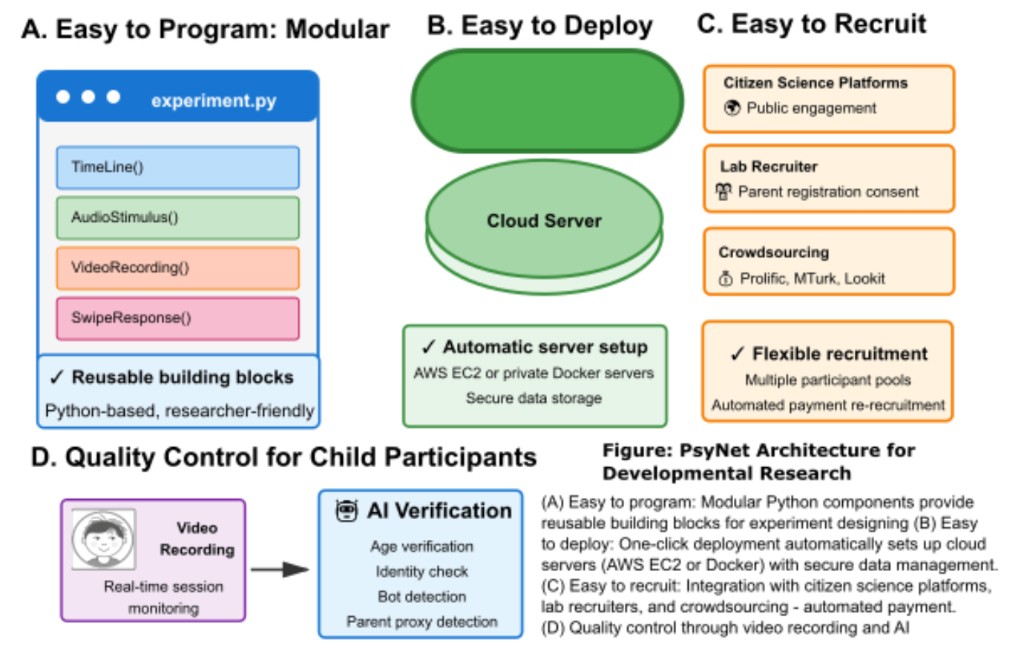
In a joint grant, we are extending PsyNet, our scalable online experimentation framework, to meet the specific needs of developmental research. The goal is to achieve greater granularity, efficiency, and global reach in studies with infants and children: running experiments that manipulate core cognitive parameters to improve the interpretability of results, including direct extensions of recent large-replication reports.
What we do
- Extend PsyNet with developmental workflows: caregiver coordination, child-friendly interfaces, video recording, AI-based age and identity verification, and adaptive protocols.
- Enable high-powered studies deployable across multiple languages, cultures, and populations, reaching populations historically excluded from developmental research.
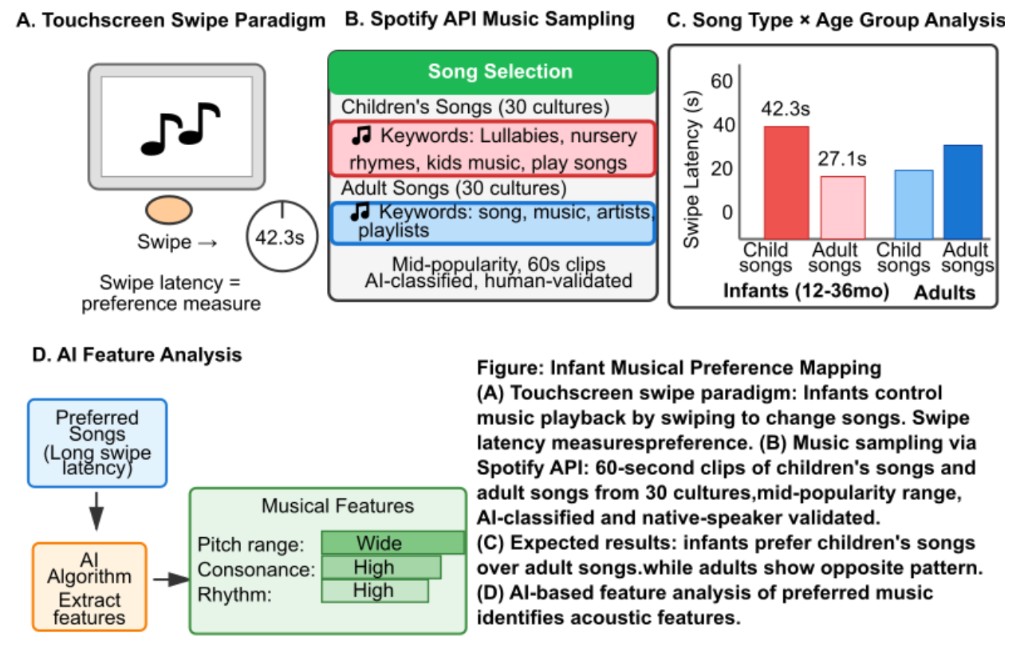
- Run empirical studies targeting core cognitive parameters, including infant music perception, statistical learning, and child-directed speech, to sharpen theoretical interpretability.
- Extend and challenge existing findings from large replication studies, contributing to a more robust and generalizable developmental science.
Why it matters
The questions developmental science asks (how minds form, how culture is transmitted, why individuals differ) are among the most fundamental in cognitive science. Yet the field’s methodological toolkit has lagged behind its ambitions. By building infrastructure that enables large-scale, cross-cultural, and theory-driven experimentation with infants and children, this project aims to transform how developmental science is conducted: generating more inclusive datasets, sharper statistical inference, and genuinely generalizable theories of early human cognition.