Cultural Evolution of Power
How distributions of decision power shape group social contracts, efficiency, fairness, and well-being.
In virtually every collective system, from small teams to online platforms to political institutions, some roles carry more decision power than others. Yet we know surprisingly little about how these distributions of power shape the outcomes that matter most: the fairness of resource allocation, the efficiency of coordination, and the well-being of participants.
In this project, we study the dynamics of small groups organized into hierarchical roles. Our goal is to understand how different distributions of power shape the group’s social contract (the implicit agreement about how resources are divided and how much autonomy each role retains) and how these arrangements affect efficiency, fairness, and well-being.
The coordinator–forager paradigm
To make these questions tractable, we run large-scale online experiments in which foragers collect resources from a virtual environment. Group performance depends in part on a coordinator, who invests in information about resource locations and assigns foragers to their initial positions.

A framework for social contracts
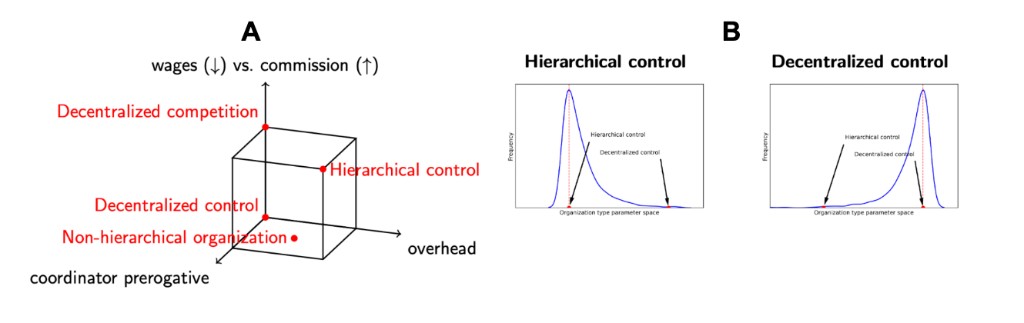
We represent the social contract along three dimensions that jointly determine how resources are distributed and how much autonomy foragers retain. This framework lets us locate and compare characteristic organizational arrangements, from decentralized competition to hierarchical control, within a single unified space.
Using an iterated-learning design, we examine which arrangements tend to persist and converge when different roles are given the authority to modify the social contract. This allows us to ask:
- If decision power rests with the coordinator (the higher-ranking role), do groups gravitate toward tighter hierarchical control?
- If a forager holds that power, do groups move toward more egalitarian structures?
- What organizational form emerges when the system is optimized for well-being?
By identifying general relationships between role structure, power, and performance, we aim to contribute to foundational research on online governance, collective intelligence, and the design of cooperative digital platforms.
People on this project



Related Publications
2026
-
In Proceedings of the Annual Meeting of the Cognitive Science Society, 2026