Opinion Diffusion in Human–AI Societies
An experimental method for studying how opinions spread and polarize in social networks of humans and language models.
As artificial intelligence increasingly mediates public discourse, it becomes important to understand how mixed collectives of humans and AI shape opinion formation and deliberation. This project develops a controlled experimental method for studying opinion dynamics in hybrid human–AI social networks.
Try it yourself: replay the example networks and paint your own to see how polarization and neighbour agreement are measured.
Human or AI participants are embedded in a 5×5 grid network that evolves over eight iterations. In each trial, a participant reads the statements of their neighbors from the previous iteration, chooses the one that best represents the group, and then revises it to reflect what that group would be likely to agree with. The revised statement becomes the new state of their node. A language model then labels every statement as positive, negative, or neutral with respect to the question, so that polarization and agreement between neighbors can be tracked over time.
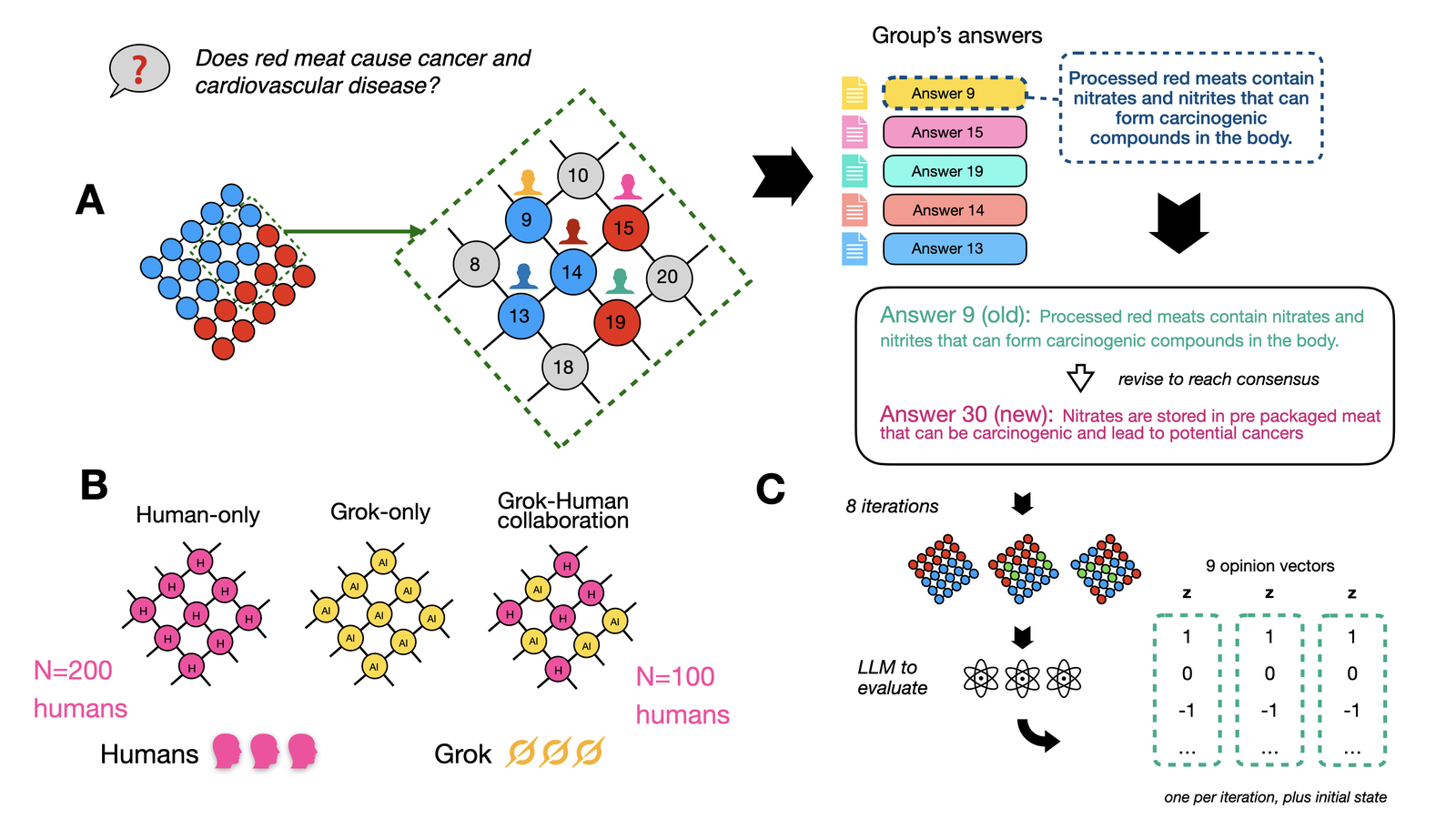
The first study compares human-only, AI-only (Grok), and hybrid networks with equal numbers of human and AI participants, using a single question: Does red meat cause cancer and cardiovascular disease? The question was chosen to be engaging while avoiding highly divisive political content.
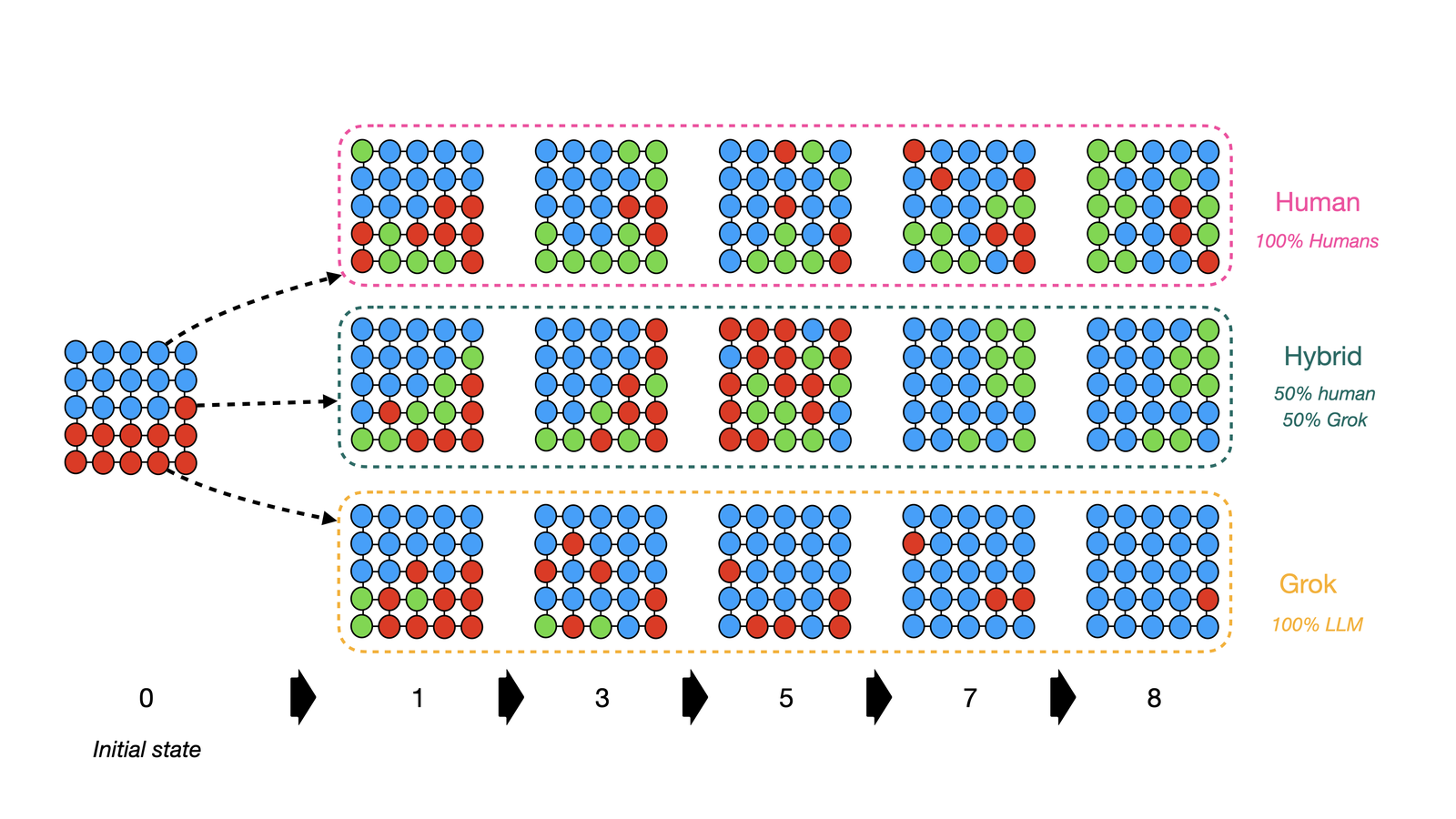
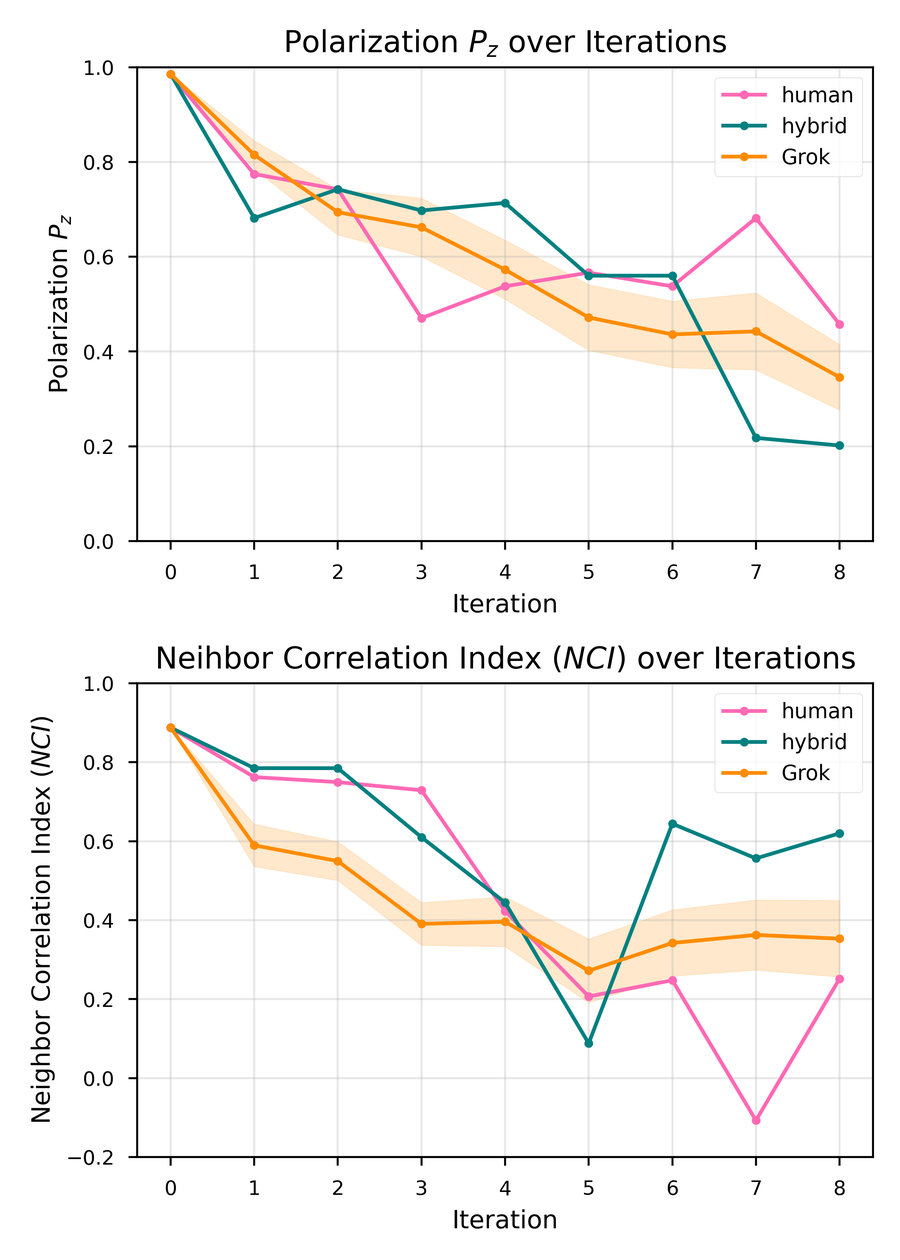
Polarization fell in all three conditions. The hybrid network ended with the lowest polarization and the highest agreement between neighbors, while the human-only network ended with the highest polarization and the lowest neighbor agreement, which may indicate that opinions mixed without forming local consensus. In AI-only networks, prompting the model toward consensus produced lower final polarization than prompting it to state its own opinion. These findings are preliminary: the human and hybrid networks were each run once, on one question, with one language model.
What we do
- Build experimental social networks in which humans and language models exchange and revise opinions, implemented with PsyNet.
- Compare how human-only, AI-only, and hybrid networks differ in polarization and neighbor agreement.
- Test how prompt framing shapes the behavior of AI participants in opinion diffusion.
- Extend the method to more questions, more runs, and more language models.
Why it matters
AI agents increasingly take part in public conversations, for example as accounts on social media platforms. Understanding how they change the way opinions spread, converge, or polarize is important for the design of these systems and for democratic deliberation. This project provides a controlled setting in which those effects can be measured directly.
People on this project




Related Publications
2026
-
In Proceedings of the Annual Meeting of the Cognitive Science Society, 2026