Iterated Learning
Using iterated reproduction to uncover perceptual priors across rhythm, space, and culture.
When we perceive complex and/or ambiguous scenes, we rely on prior information in order to make sense of what we see or hear. These perceptual priors therefore exercise a powerful influence on how and what we actually perceive. One of the core paradigms we employ to investigate these priors is iterated learning, in which subjects attempt to reproduce initially random stimuli and the results of their efforts are then repeatedly fed back to them to become the next experimental stimulus (think of the game of “telephone”). After a few such iterations, we can efficiently estimate the subject’s perceptual priors from the probability distribution of the reproductions.
In the auditory domain, we have applied this paradigm to investigate perceptual priors by studying the iterated learning of simple musical rhythms in 39 diverse groups from 15 countries. Every culture we have tested exhibits priors with discrete modes, but the relative importance of different modes varies across groups, reflecting exposure to local music.
Try it yourself: play rhythm telephone: tap a random rhythm back, round after round, and watch it drift toward the rhythms you expect.
We have expanded this approach to the visual modality studying spatial memory priors. Based on our experimental findings, we introduced a theoretical model that reinterprets spatial memory priors as reflecting an optimal allocation of perceptual resources.
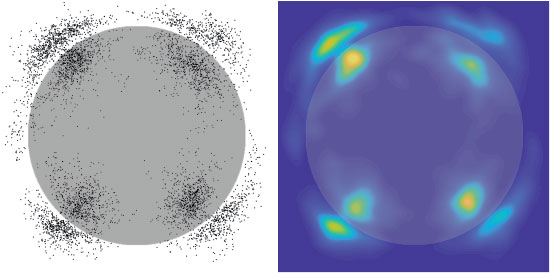
(Jacoby & McDermott, 2017; Jacoby et al., 2024; Anglada-Tort et al., 2023; Langlois et al., 2021)
People on this project




Related Publications
2024
2023
2021
-
Proceedings of the National Academy of Sciences, 2021
2017
-
Current Biology, 2017