Popularity Feedback and Niche Construction
How popularity information shapes innovation, diversity, and long-term cultural trajectories in creative markets.
Creative systems often depend on feedback loops between selection and creation: people choose from a cultural market, transform what they select, and then add their own creations back into the environment for others to evaluate. When popularity information is visible, these feedback loops can generate herd behavior and cumulative advantage, where popular options attract more attention simply because they are already popular.
This project asks how popularity feedback changes collective creativity. Does visibility of popularity improve coordination and quality, or does it constrain exploration? Can cumulative advantage alter not only what people select, but also the form and direction of the new cultural variants they create?
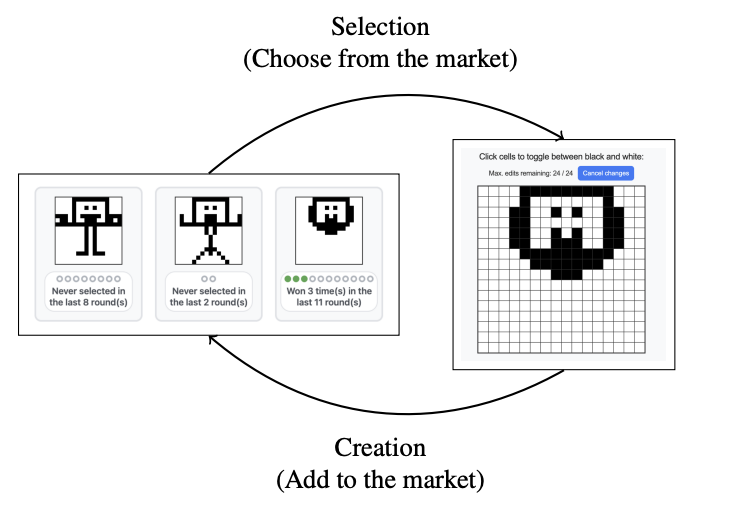
To address these questions, we run large-scale online experiments in which participants iteratively interact with evolving image markets. In one condition, participants see popularity information about the images available in the market; in the other, they make selections without such social information. This design isolates how popularity feedback changes cultural evolution across many generations.
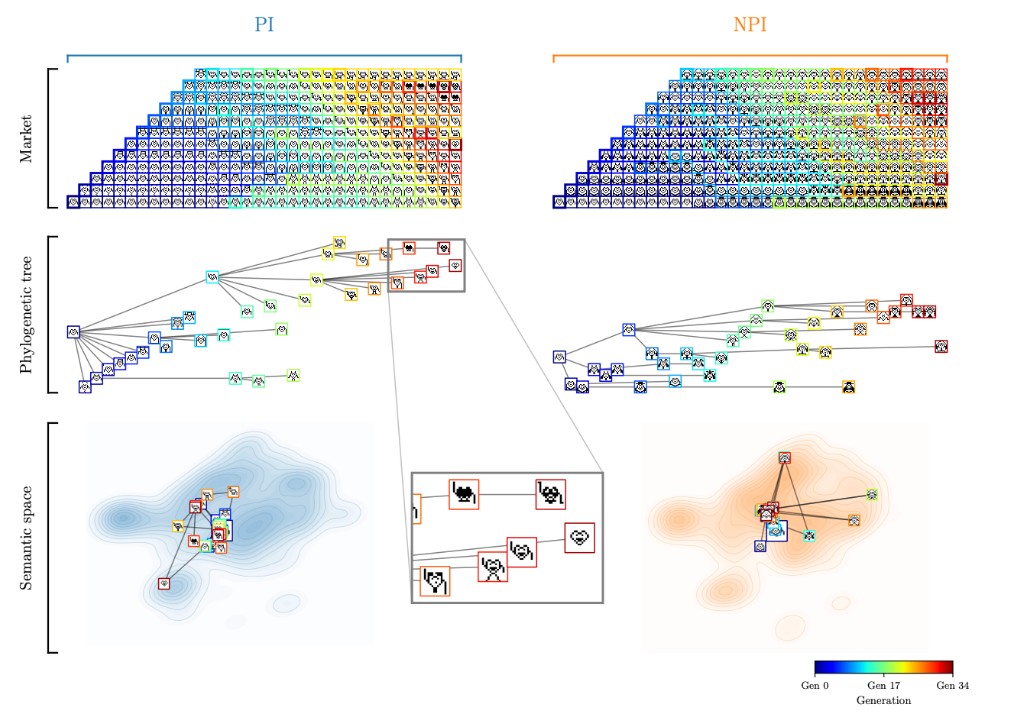
The results show that popularity information can reduce cultural diversity, slow innovation, and delay aesthetic improvements. These effects arise through both sides of the creative loop: popularity changes what people choose to build on, and it also changes how disruptively they modify what they inherit.
What we do
- Conduct large-scale creative market experiments in which participants repeatedly select, modify, and contribute cultural artifacts.
- Manipulate popularity visibility to test its causal effects on selection, creation, diversity, and innovation.
- Track market dynamics, phylogenetic structure, and semantic exploration across generations of cultural transmission.
- Model how participants select and modify images, and relate the effects of popularity feedback to accounts of cultural niche construction.
Why it matters
Popularity feedback underlies many modern social dynamics, from viral media and cultural trends to scientific citation cascades and online recommendation systems. Understanding how popularity signals shape collective creativity is crucial for designing platforms and institutions that balance coordination, diversity, and innovation. This work contributes to theories of cultural evolution and informs the design of social information systems that promote exploration rather than entrenchment.
People on this project




Related Publications
2026
-
In Proceedings of the Annual Meeting of the Cognitive Science Society, 2026