Virtual Worlds
Using online virtual worlds to study governance, collective intelligence, public goods, and social feedback.
Many forms of collective intelligence depend on public goods. Ratings, recommendations, votes, institutional rules, and shared resources can help groups solve problems, but they also require individuals to contribute information or effort that others may use for free.
This project uses online virtual worlds to study how governance systems shape coordination, fairness, efficiency, and collective learning. By embedding social dilemmas inside interactive games, we can experimentally vary incentives, feedback systems, and institutional rules while observing how individual decisions scale into group-level outcomes.
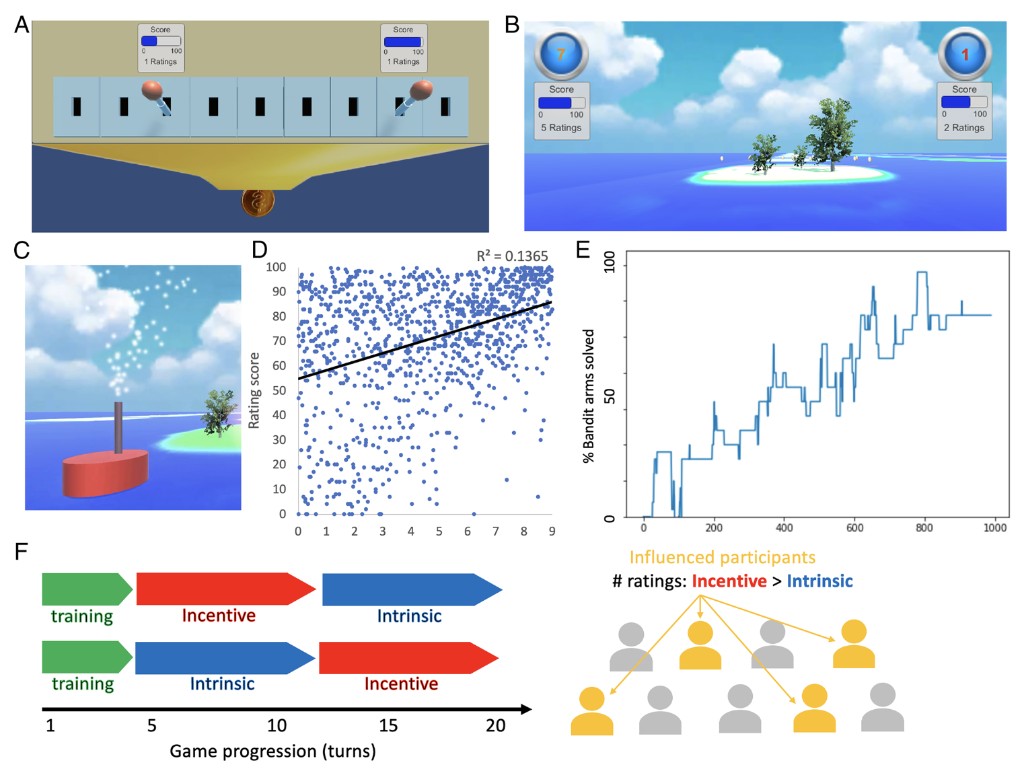
In one line of work, virtual-world bandit games show that collective intelligence is not simply a matter of collecting more opinions from the most intrinsically motivated contributors. In the free-riders study, participants who were initially less willing to contribute ratings gave more accurate evaluations, and incentivizing them to participate amplified their influence without altering the quality of their evaluations, improving collective intelligence. This reframes free riding as a design problem: collective intelligence can improve when systems recruit a broader diversity of motivations instead of relying only on volunteers.
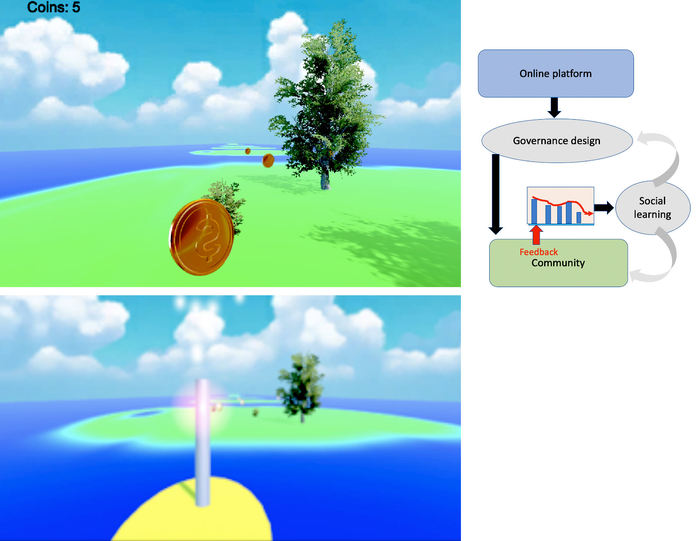
Across related studies, we use virtual worlds to ask how online societies organize themselves. We examine how participant-created cultural goods spread under different sharing constraints, how recommendation and rating systems alter collective behavior, and how people choose among governance structures when rules affect public goods and resource allocation.
Research Questions
- How do incentives change who contributes information to public recommendation systems?
- When do social feedback systems improve collective intelligence, and when do they amplify bias or inequality?
- How do groups choose institutional rules for creating, sharing, rating, and distributing resources?
- What forms of virtual-world governance produce better trade-offs among efficiency, fairness, autonomy, and well-being?
People on this project


Related Publications
2025
-
-
arXiv preprint arXiv:2502.16677, 2025
2023
-
Proceedings of the National Academy of Sciences, 2023