Gibbs Sampling with People
Using collective human behavior to implement probabilistic inference and generative modeling.
As cognitive scientists, we are often interested in mapping the relationship between external stimuli (e.g., spoken sentences, musical chords, faces) and semantic features that the mind derives from these stimuli (e.g., happiness, sadness, pleasantness). Traditional methods for studying such relationships (e.g., non-adaptive rating experiments) work well when the stimulus spaces are low-dimensional and the semantic features are simple, but struggle when applied to more complex cognitive domains.
We have developed a new technique, termed Gibbs Sampling with People (GSP), designed to overcome this problem. This is an adaptive technique, inspired by the Gibbs Sampling method from computational statistics and machine learning, where many participants collaborate to navigate a stimulus space and identify regions associated with a given semantic concept, for example “pleasantness.”
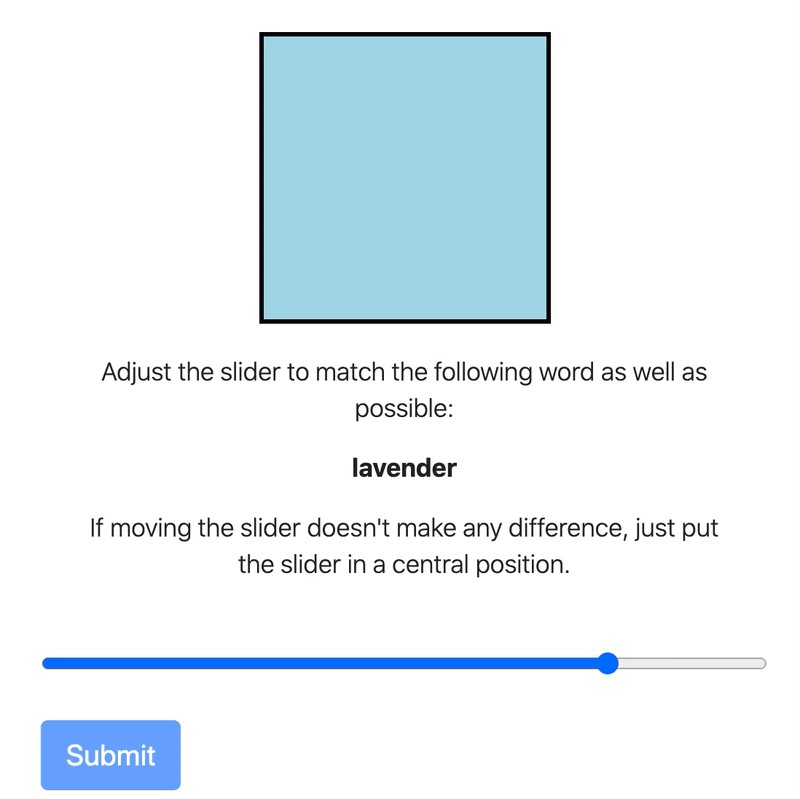
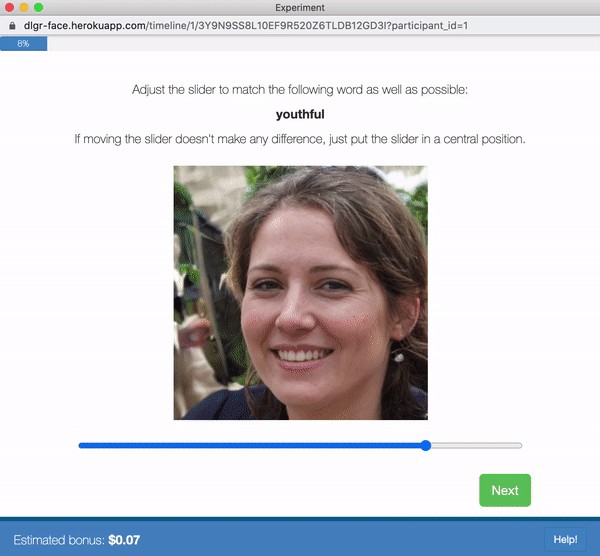
In each trial, the participant is presented with a stimulus and a slider, where the slider is coupled to a particular dimension of the stimulus space that changes from trial to trial. The participant is instructed to move the slider to find the stimulus most associated with the target semantic concept. The resulting stimulus is then passed along the chain of participants, with each successive participant optimizing a different dimension. Under our cognitive decision model, the emergent process corresponds to a Gibbs sampler that maps the relationship between the stimulus space and the target semantic concept.
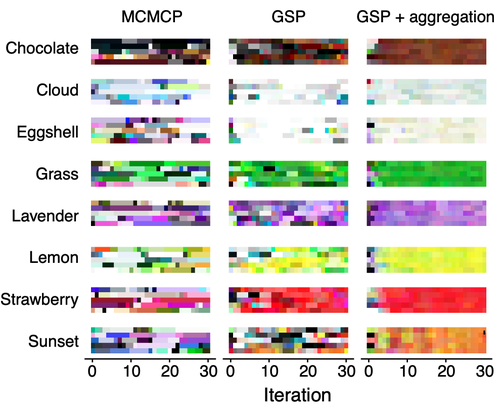
Try it yourself: find the colour of a word, one slider at a time, using the eight words from the paper’s colour experiment.
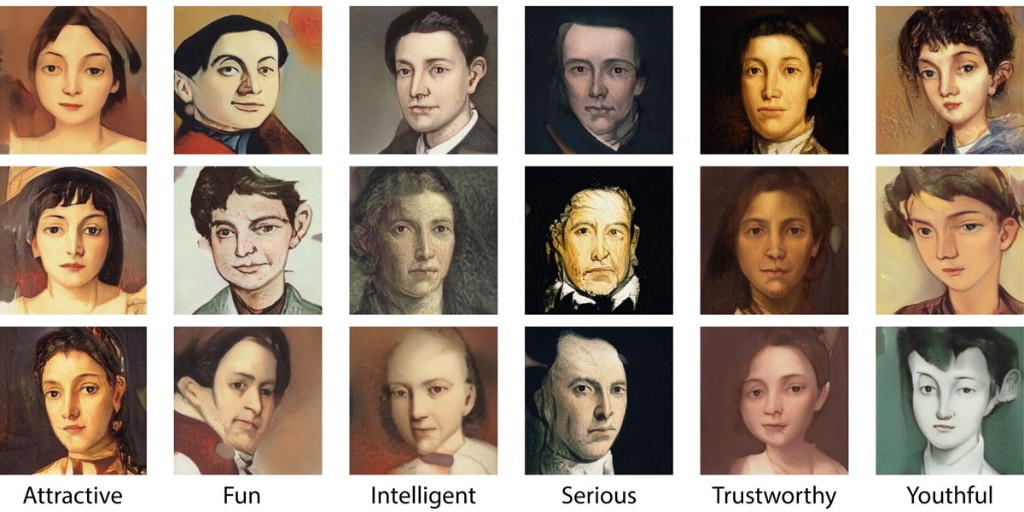
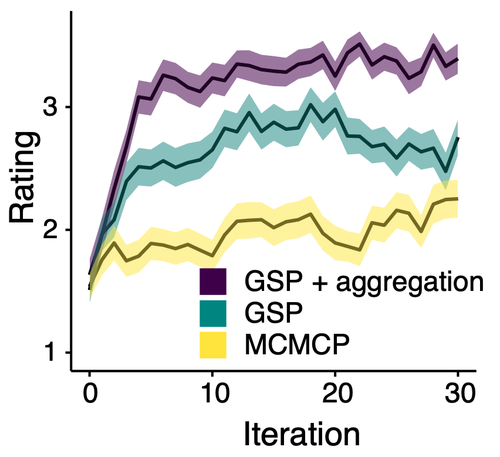
In a recent paper (Harrison et al., NeurIPS 2020), we demonstrate this technique in four different domains that vary substantially in complexity: colors, musical chords, emotional prosody, and faces. We show that the method generalizes well to these different domains, generating interpretable and interesting results. Further, we show that the method can be coupled with state-of-the-art deep neural synthesis models to study the perception of very high-dimensional stimulus spaces, such as natural images.
The slider interface
GSP versus prior methods
Sound examples
Related work generalizes this idea of adapting an experiment to participants’ responses as they arrive. Active Inference with People combines active inference, probabilistic programming with Pyro, and PsyNet to run real-time adaptive experiments, reducing the number of trials needed to estimate ability by 30–40% in an adaptive testing example.
(Harrison et al., 2020; van Rijn et al., 2021; Van Geert & Jacoby, 2024; Gautheron et al., 2026)
People on this project







Related Publications
2026
-
arXiv preprint arXiv:2603.29003, 2026
2024
-
In Proceedings of the Annual Meeting of the Cognitive Science Society, 2024
2021
-
arXiv preprint arXiv:2105.01891, 2021