Cultural Evolution Mechanisms
Disentangling how topology, selection, and reproduction interact in experimental cultural evolution.
Cultural evolution is rarely driven by a single force. Cultural change depends on how people are connected, which variants they choose to imitate, and how faithfully or creatively they reproduce what they observe. This project uses experimental social networks to characterize how these mechanisms interact.
Participants reproduce short melodies while embedded in different social network topologies. By manipulating network structure, selection, and reproduction, the experiment reveals how local interactions can generate population-level cultural structure, including shared melodic prototypes, diversity, and differences in aesthetic value.
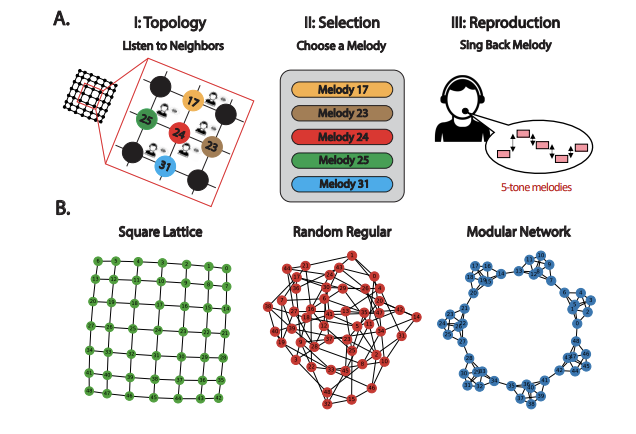
The paradigm makes it possible to study cultural evolution as a system of interacting mechanisms rather than isolated effects. Network topology determines which cultural variants are available locally; selection determines which variants are preferentially chosen; reproduction determines how variants are transformed as they pass from person to person.
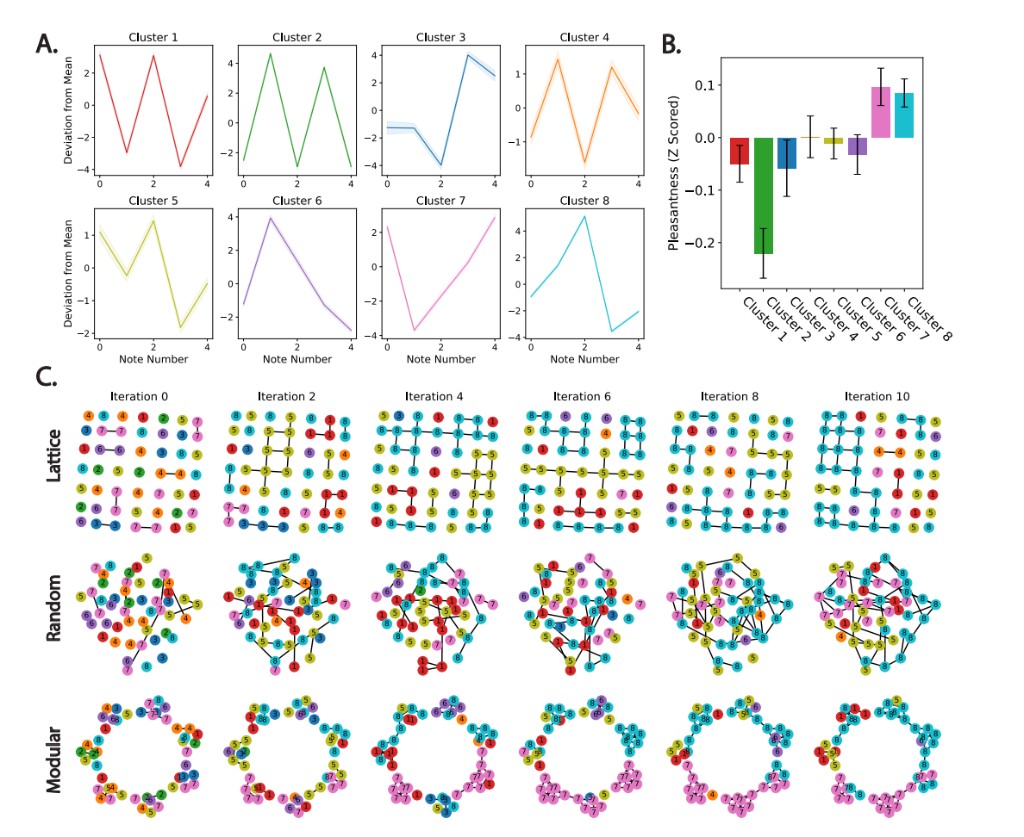
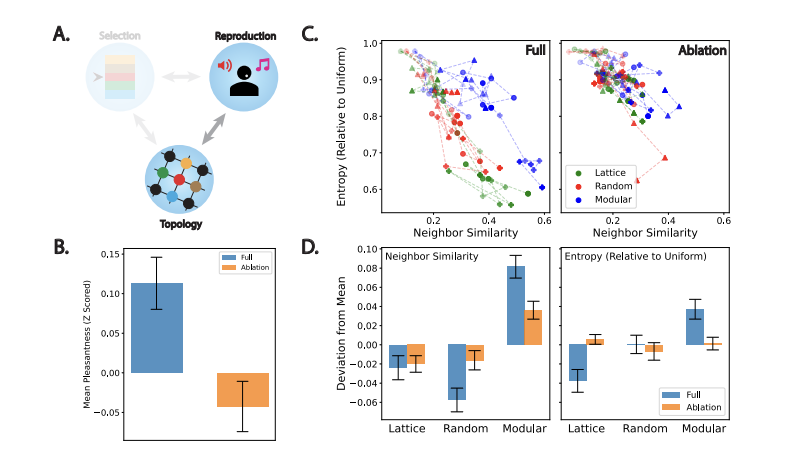
The experiments compare lattice, random regular, and modular networks that are locally identical but globally different: every participant chooses among the same number of melodies. Even so, topology shaped population-level structure, with the modular network producing distinct musical cliques, higher neighbor similarity, and higher entropy. These effects largely disappeared when selection or reproduction was removed, suggesting that both are needed.
What we do
- Decompose cultural evolution into interacting mechanisms of topology, selection, and reproduction.
- Use networked melody transmission experiments to observe how local imitation scales into population-level cultural structure.
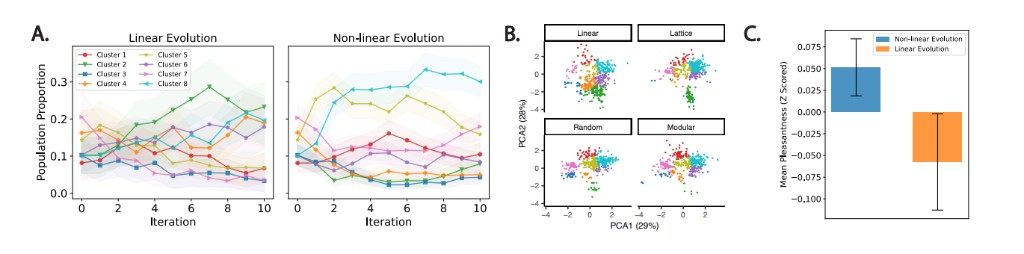
- Compare linear transmission with networked transmission across lattice, random, and modular social structures.
- Analyze emergent prototypes, pleasantness, entropy, and neighbor similarity over time.
Why it matters
Understanding cultural evolution requires knowing how mechanisms combine. Selection can favor appealing variants, reproduction can transform them, and topology can determine which variants meet and compete. This work provides an experimental framework for studying those interactions directly, helping explain when cultural systems converge, diversify, or settle into distinct local traditions.
Related work asks how constraints on reproduction shape collective creativity. When participants in transmission chains could change only a few notes of a melody at a time, the resulting tunes became more pleasant, whereas the same constraint reduced the pleasantness of images. This suggests that in domains where artifacts are easily damaged, collective creativity may benefit from small steps.
People on this project





Related Publications
2025
-
arXiv preprint arXiv:2502.12847, 2025
-
arXiv preprint arXiv:2502.16694, 2025