Cross-Cultural Perception
Understanding how culture and experience shape perceptual representations across populations.
Over 90% of psychology experiments published between 2003 and 2007 were conducted on participants from Western, Educated, Industrialized, Rich, and Democratic (WEIRD) societies, raising fundamental concerns about the generalizability of cognitive science. This project investigates how culture, learning, and experience shape perceptual representations, with a focus on sound and music.
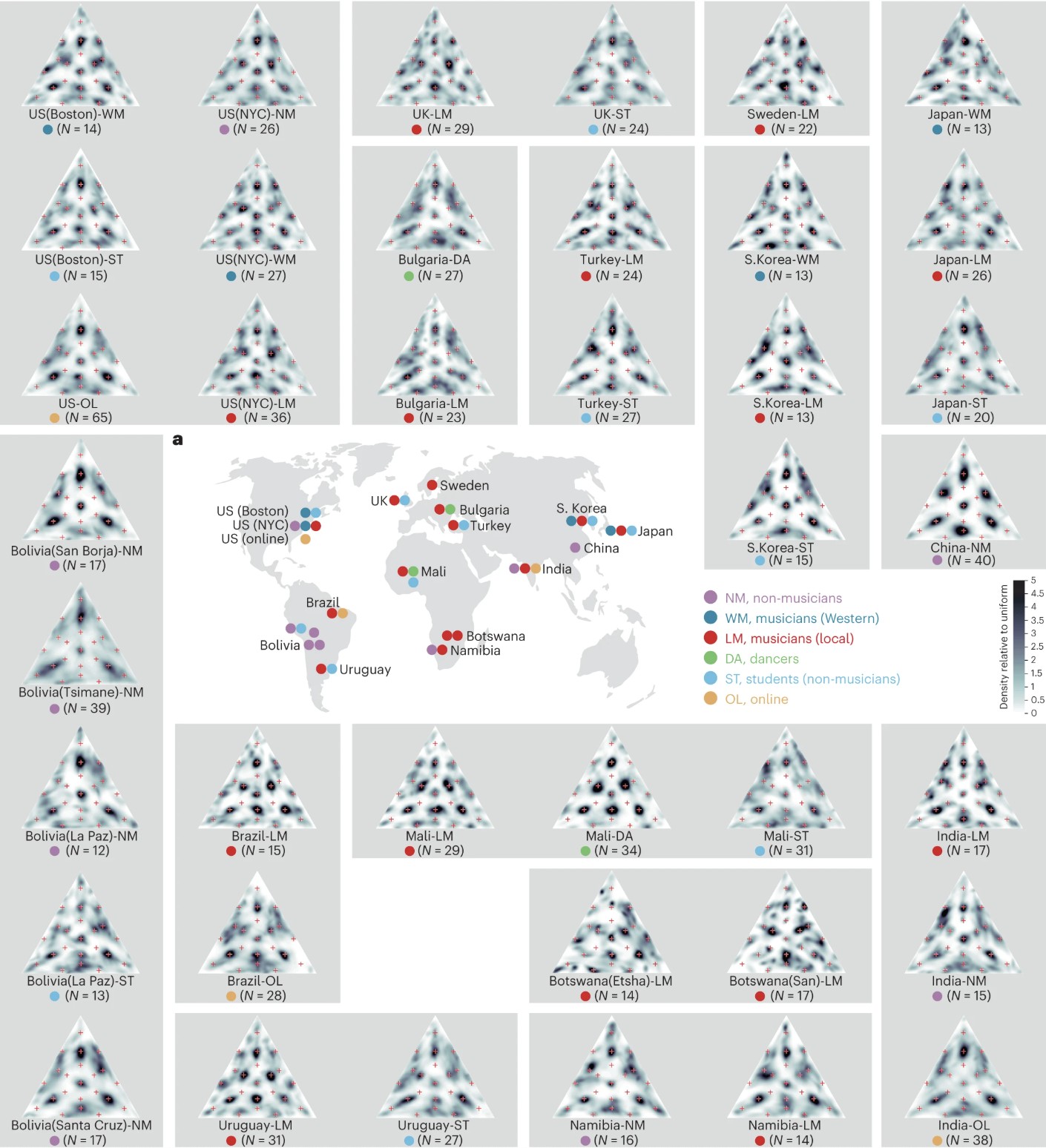
By integrating behavioral experiments, computational modeling, and global fieldwork, we characterize how exposure to different musical systems shapes internal representations of rhythm, pitch, consonance, and melody. Our goal is to disentangle universal perceptual principles from culture-specific adaptations, revealing how human perception co-evolves with cultural environments.
The same approach extends beyond perceptual structure to emotion and aesthetics. Using bottom-up, participant-generated emotion terms rather than translated English categories, we find a valence–arousal structure shared across cultures alongside clear differences in how dictionary-equivalent emotion terms are understood. Large-scale studies of visual and auditory aesthetic preferences across 10 countries similarly reveal both universal patterns, such as a preference for symmetry, and cultural variation, which is greatest for melody.
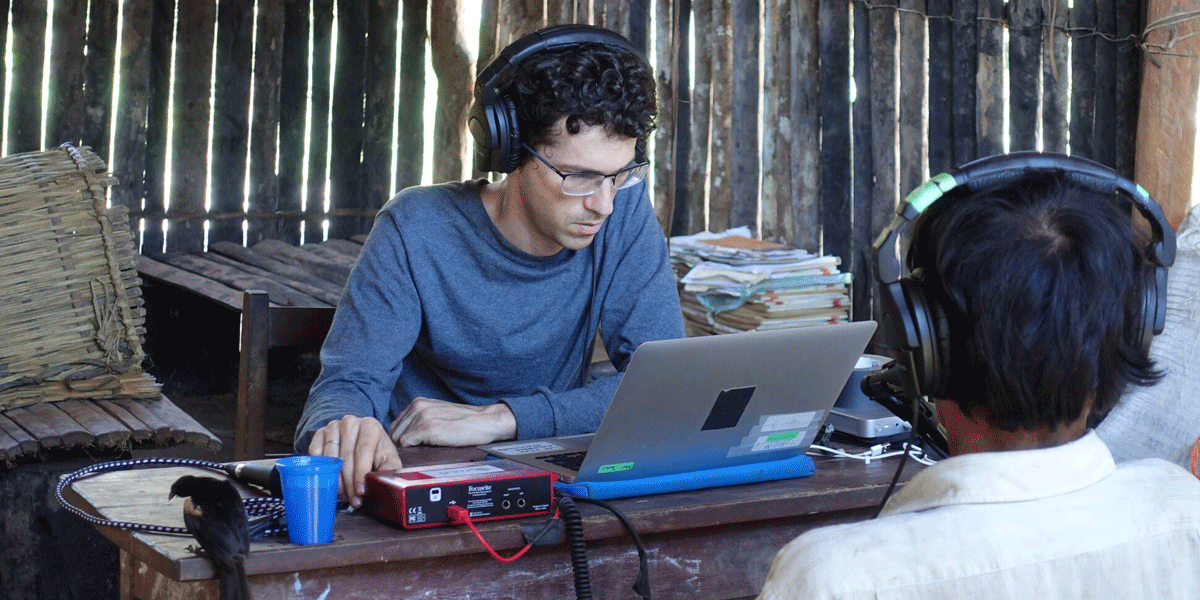
To bypass linguistic and instructional barriers common in cross-cultural research, we design experiments in which participants interact directly with auditory stimuli through singing, tapping, gesturing, and imitation. These paradigms allow us to probe perceptual structure even in populations with limited exposure to formal experimental settings.
We have conducted fieldwork and large-scale studies with diverse populations ranging from West African drummers and Amazonian communities to Bulgarian folk musicians and Uruguayan candombe players, and have built a global research network spanning fifteen countries. This network emphasizes local scientific collaboration, inclusion of underrepresented groups, and shared ownership of research questions and methods.
What we do
- Conduct large-scale behavioral experiments across diverse global populations and musical traditions.
- Develop non-verbal experimental paradigms based on singing, tapping, imitation, and gesture.
- Use iterated learning, psychophysics, and computational modeling to reconstruct latent perceptual representations.
- Characterize cross-cultural variation in rhythm, pitch, and harmony perception.
- Build and maintain global research networks supporting inclusive, collaborative cross-cultural science.

Why it matters
Understanding how culture shapes perception is essential for building generalizable theories of cognition. This work informs debates about universality versus cultural specificity, advances models of perceptual learning, and guides the design of culturally adaptive technologies. More broadly, it provides a foundation for understanding how perceptual systems emerge through the interaction of biology, learning, and cultural transmission.
People on this project








Related Publications
2026
-
Physics of Life Reviews, 2026
2025
-
arXiv preprint arXiv:2502.08744, 2025
-
arXiv preprint arXiv:2505.09539, 2025
-
arXiv preprint arXiv:2502.14439, 2025
2024
2023
-
In The science-music borderlands: Reckoning with the past and imagining the future, 2023
2021
-
Philosophical Transactions of the Royal Society B: Biological Sciences, 2021
-
arXiv preprint arXiv:2108.00768, 2021
2020
-
Nature communications, 2020
-
Music Perception, 2020
2019
-
Current Biology, 2019
2018
-
Music Perception: An Interdisciplinary Journal, 2018