Cross-cultural perception
Understanding how culture and experience shape perceptual representations across populations.
Over 90% of psychological experiments have historically been conducted on participants from Western, Educated, Industrialized, Rich, and Democratic (WEIRD) societies, raising fundamental concerns about the generalizability of cognitive science. This project investigates how culture, learning, and experience shape perceptual representations, with a focus on sound and music.
By integrating behavioral experiments, computational modeling, and global fieldwork, we characterize how exposure to different musical systems shapes internal representations of rhythm, pitch, consonance, melody, and timbre. Our goal is to disentangle universal perceptual principles from culture-specific adaptations, revealing how human perception co-evolves with cultural environments.
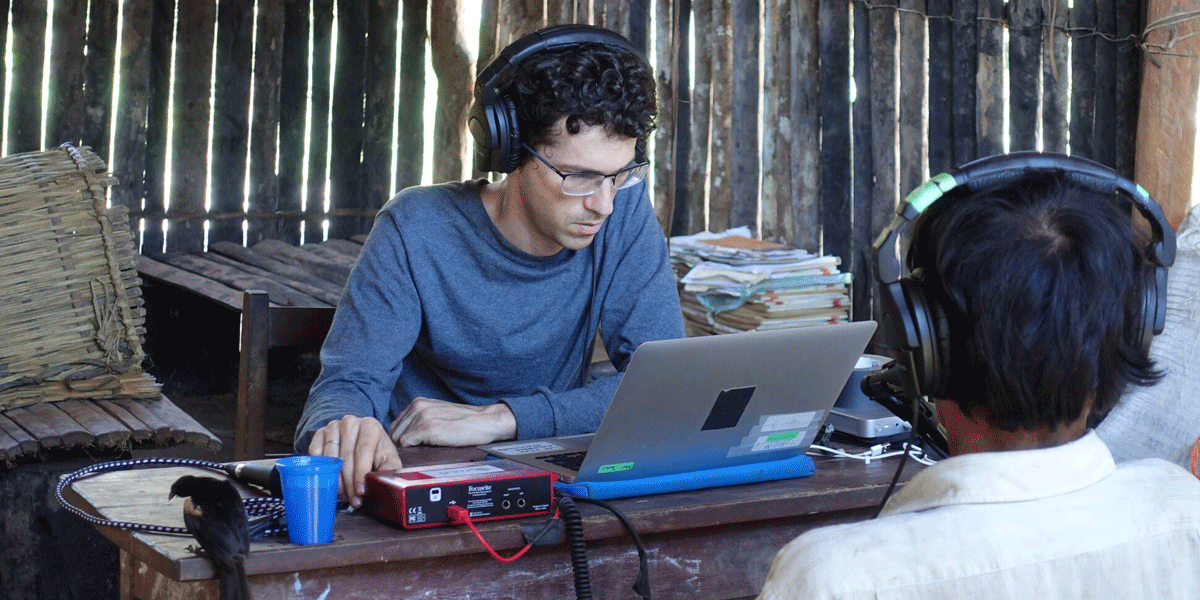
To bypass linguistic and instructional barriers common in cross-cultural research, we design experiments in which participants interact directly with auditory stimuli through singing, tapping, gesturing, and imitation. These paradigms allow us to probe perceptual structure even in populations with limited exposure to formal experimental settings.
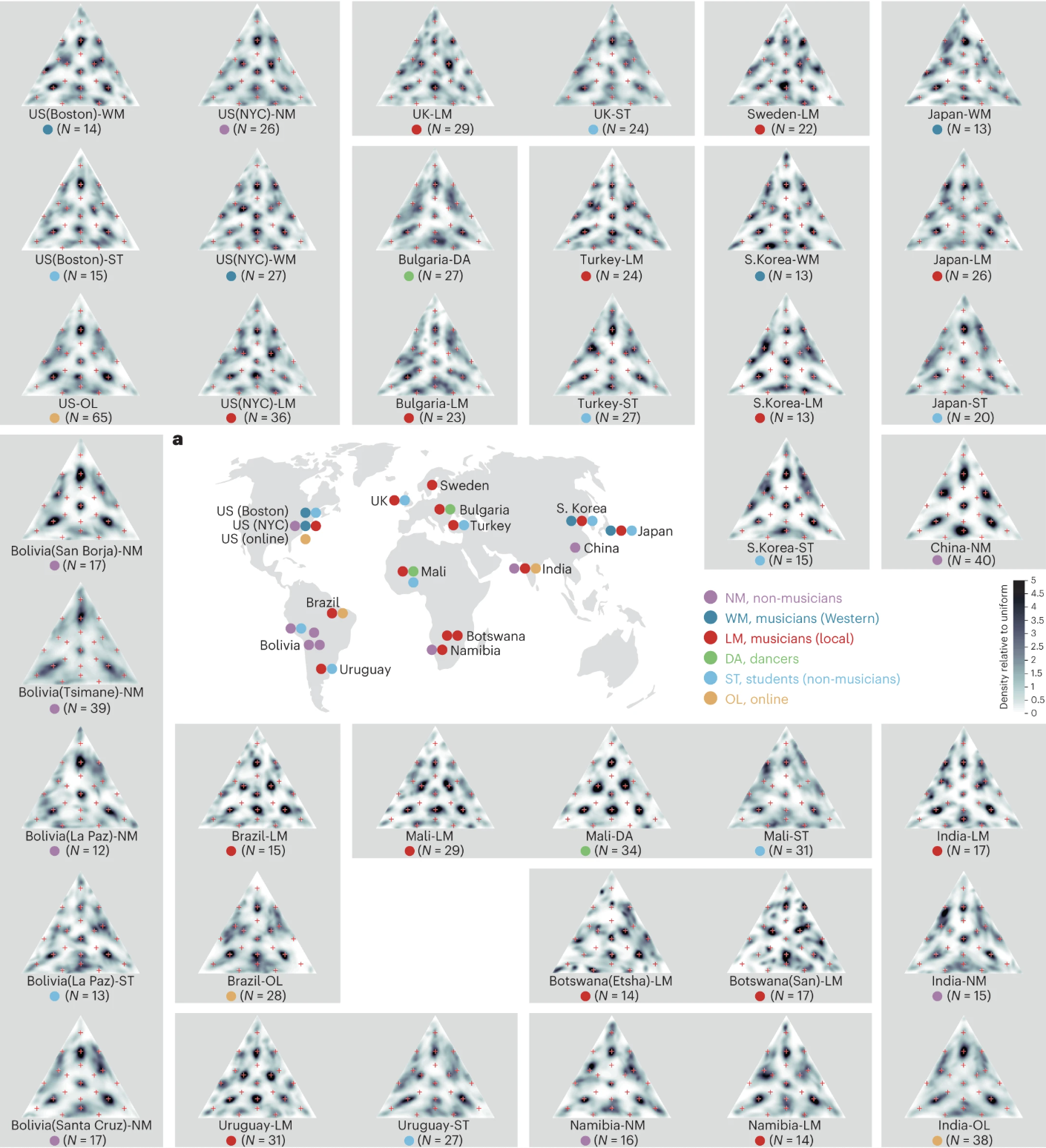
We have conducted fieldwork and large-scale studies with diverse populations ranging from West African drummers and Amazonian communities to Bulgarian folk musicians and Uruguayan candombe players, and have built a global research network spanning over fifteen countries. This network emphasizes local scientific collaboration, inclusion of underrepresented groups, and shared ownership of research questions and methods.
What we do
- Conduct large-scale behavioral experiments across diverse global populations and musical traditions.
- Develop non-verbal experimental paradigms based on singing, tapping, imitation, and gesture.
- Use iterated learning, psychophysics, and computational modeling to reconstruct latent perceptual representations.
- Characterize cross-cultural variation in rhythm, pitch, harmony, and timbre perception.
- Build and maintain global research networks supporting inclusive, collaborative cross-cultural science.

Why it matters
Understanding how culture shapes perception is essential for building generalizable theories of cognition. This work informs debates about universality versus cultural specificity, advances models of perceptual learning, and guides the design of culturally adaptive technologies. More broadly, it provides a foundation for understanding how perceptual systems emerge through the interaction of biology, learning, and cultural transmission.
Related Publications
2024
-
Commonality and variation in mental representations of music revealed by a cross-cultural comparison of rhythm priors in 15 countriesNature Human Behaviour, Mar 2024
2021
-
Building sustainable global collaborative networks: Recommendations from music studies and the social sciencesJun 2021
-
Extreme precision in rhythmic interaction is enabled by role-optimized sensorimotor coupling: analysis and modelling of West African drum ensemble musicPhilosophical Transactions of the Royal Society B, Aug 2021
-
Cross-cultural mood perception in pop songs and its alignment with mood detection algorithmsarXiv, Aug 2021
2020
-
Perceptual fusion of musical notes by native Amazonians suggests universal representations of musical intervalsNature Communications, Jun 2020
-
2019
-
Universal and Non-universal Features of Musical Pitch Perception Revealed by SingingCurrent Biology, Oct 2019