Dynamics of Collective Creativity
How human-only, AI-only, and human-AI social networks shape creativity and diversity in evolving stories.
Collective creativity is increasingly shaped by interactions between people and generative AI systems. This project studies how creative artifacts evolve when they are produced, selected, modified, and transmitted through social networks composed of humans, AI agents, or hybrid human-AI groups.
Using a creative writing paradigm, participants join 5×5 grid-based social networks in which short stories are repeatedly selected and transformed over many iterations. This allows us to measure not only the quality of creative products, but also the dynamics by which creativity, diversity, and semantic structure change over time.
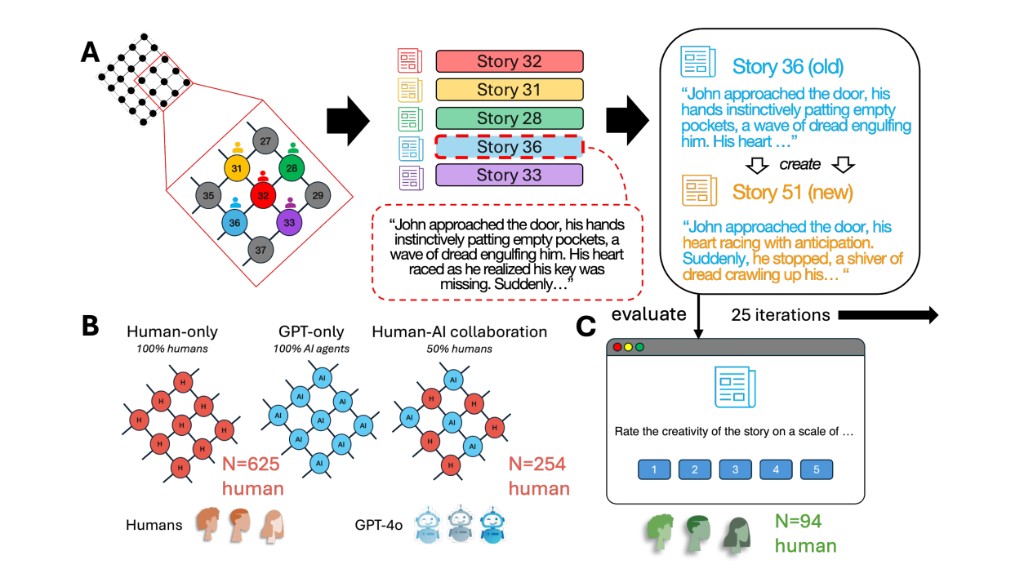
The experiments compare three kinds of creative systems: fully human networks, fully AI networks, and mixed human-AI networks. This design lets us ask whether AI amplifies creative quality, whether it narrows or broadens the diversity of cultural output, and how hybrid systems differ from either humans or AI alone.
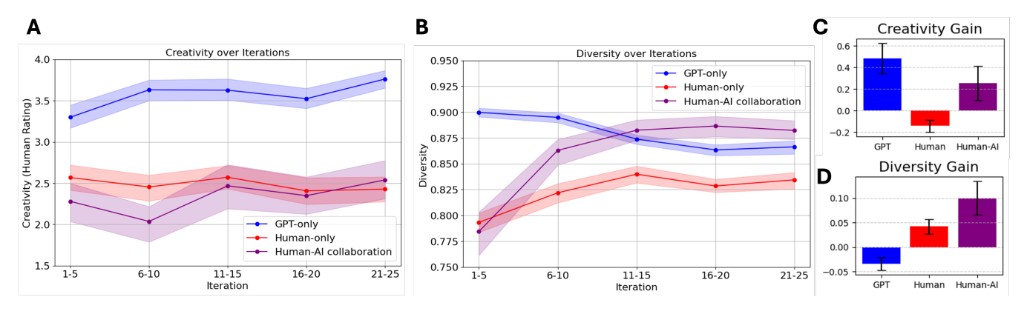
The results show that creative systems differ not only in final quality but also in their trajectories. GPT-only networks can rapidly increase rated creativity, while human-AI networks preserve and amplify diversity in ways that differ from both human-only and AI-only systems. These dynamics suggest that hybrid creative societies may support distinct forms of exploration, recombination, and cultural differentiation.
What we do
- Build controlled creative transmission experiments in human-only, AI-only, and human-AI social networks.
- Measure how creativity and diversity change across repeated selection and modification.
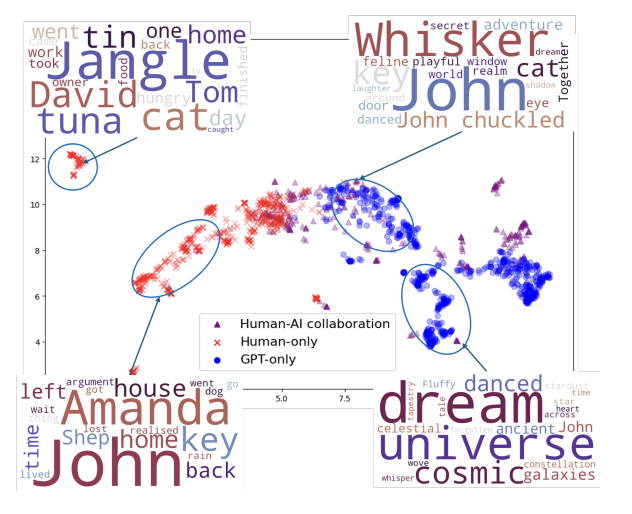
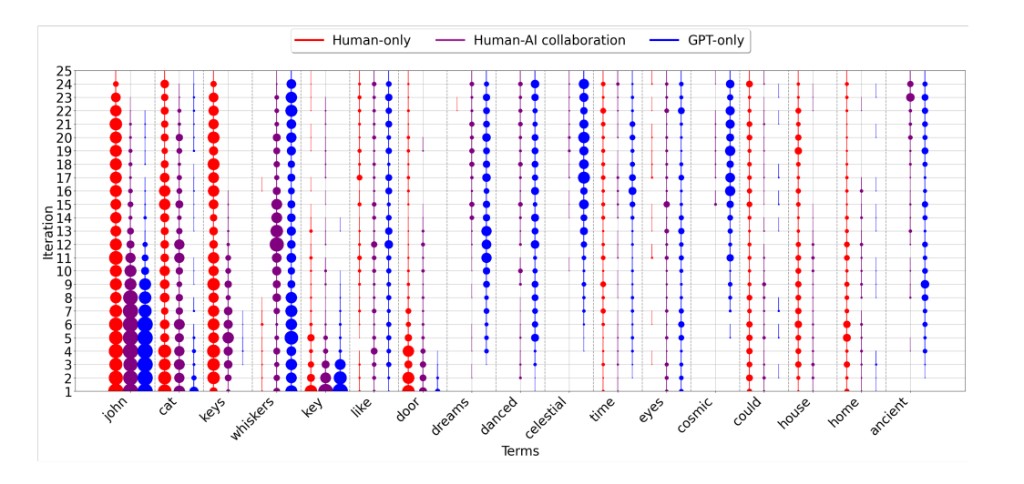
- Analyze semantic trajectories using embeddings, clustering, and term-level dynamics.
- Identify when AI systems amplify creativity, when they homogenize output, and when hybrid groups preserve richer diversity.
Why it matters
Generative AI is becoming part of everyday creative work, but its effects on collective creativity depend on the structure of interaction. This project treats human-AI creativity as a cultural-evolution process, showing how network composition and transmission dynamics shape both the quality and diversity of creative output.
People on this project



Related Publications
2026
2025
-
arXiv preprint arXiv:2502.17962, 2025